Blog
Day and Night Blinds Explained: How They Work and Why You’ll Love Them

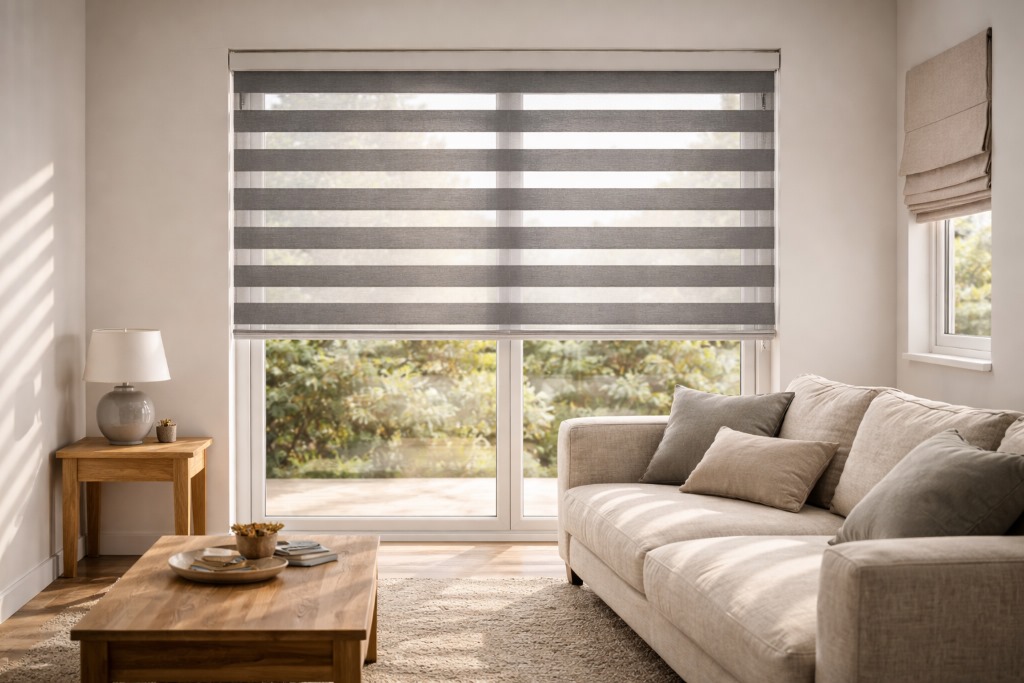
If you’ve been searching for window blinds recently, you’ve probably noticed an increasingly popular option: day and night blinds. Also called zebra blinds, vision blinds, or duo blinds, these clever window treatments have become one of Ireland’s fastest-growing blind styles-and for good reason.
At Dublin Blinds, we’ve seen day and night blind orders surge as homeowners discover their unique versatility. But how exactly do they work? And are they right for your home? This comprehensive guide explains everything you need to know about this innovative blind style.
What Are Day and Night Blinds?
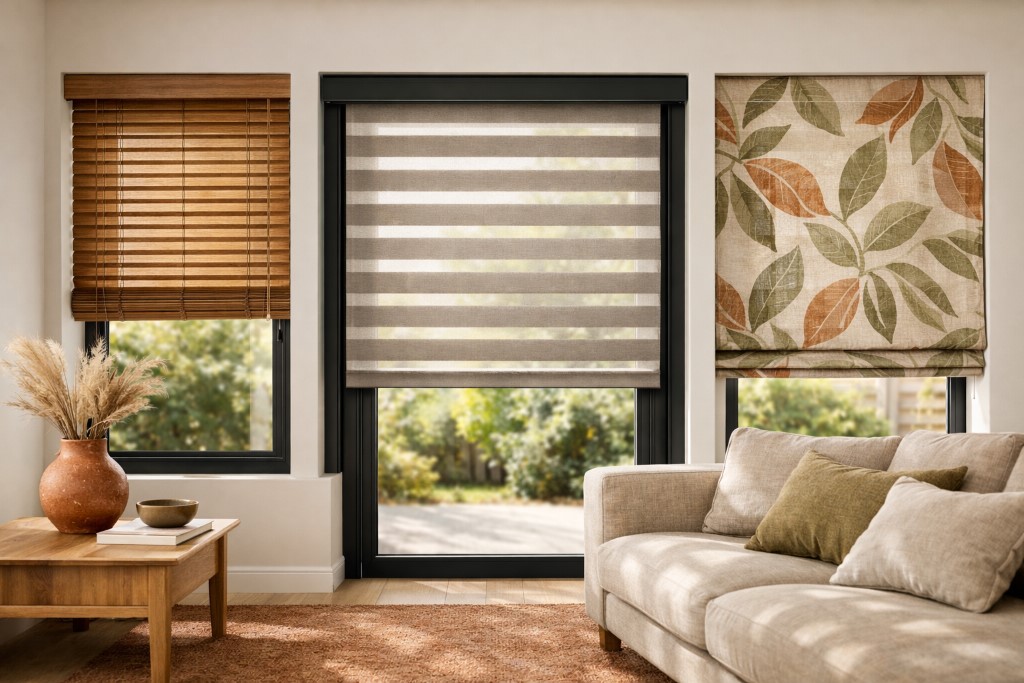
Day and night blinds are a type of roller blind with a unique twist: instead of solid fabric, they feature alternating horizontal stripes of sheer and opaque material. By raising or lowering the blind, you can align or offset these stripes to create different levels of light and privacy.
The Names Explained
- Day and night blinds: Named for their ability to provide suitable covering for both daytime (sheer) and nighttime (privacy)
- Zebra blinds: Named for the striped pattern resembling zebra markings
- Vision blinds: Refers to the ability to see through the sheer stripes
- Duo blinds: Describes the dual fabric layers that work together
- Double roller blinds: References the two layers of striped fabric
All these names describe the same product-choose whichever term makes most sense to you!
How Do Day and Night Blinds Work?
The magic of day and night blinds lies in their construction. Unlike standard roller blinds with a single layer of fabric, day and night blinds feature two layers of striped fabric that loop continuously around the roller mechanism.
The Mechanism
Each layer has alternating stripes:
- Sheer stripes: Semi-transparent fabric that allows light through while providing some privacy
- Opaque stripes: Solid fabric that blocks light and provides complete privacy
As you adjust the blind’s position, the two fabric layers move against each other:
Position 1: Full Light
When the sheer stripes on both layers align, light flows freely through the window. You can see out (though views are softened), and your room fills with natural daylight. This is perfect for daytime use.
Position 2: Full Privacy
When the opaque stripes overlap and align, light is blocked and privacy is complete. No one can see in, and your room darkens significantly. Ideal for evenings and nighttime.
Position 3: Adjustable
Any position between fully aligned creates varying degrees of light filtering. You can fine-tune the exact amount of light and privacy to suit the moment-bright and airy for morning coffee, softly filtered for afternoon work, private for evening relaxation.
Benefits of Day and Night Blinds
Unmatched Light Control
No other blind style offers such precise, instant light adjustment. From full sunlight to near-blackout, everything is controlled by simply raising or lowering the blind slightly. There are no cords to twist, slats to tilt, or separate mechanisms to manage.
Privacy On Demand
Need privacy during the day without losing all your light? Day and night blinds deliver. The sheer stripes obscure views from outside while still allowing daylight to enter-similar to net curtains but with a contemporary aesthetic.
Two Functions, One Blind
Traditionally, achieving both daytime privacy and nighttime blackout required two window treatments-perhaps a sheer and a blind, or a voile and curtains. Day and night blinds combine both functions in a single, streamlined solution.
Modern, Clean Aesthetic
The horizontal striped pattern creates a contemporary look that suits modern interiors perfectly. Clean lines, no dangling cords or complicated mechanisms visible-just elegant simplicity.
Easy Operation
One continuous motion controls everything. No separate controls for different functions. Children and elderly family members find them intuitive to use.
Space-Saving
Because they replace two window treatments with one, day and night blinds save space in your window recess and create a less cluttered appearance.
Day and Night Blinds vs Other Blind Types
How do day and night blinds compare to other popular options?
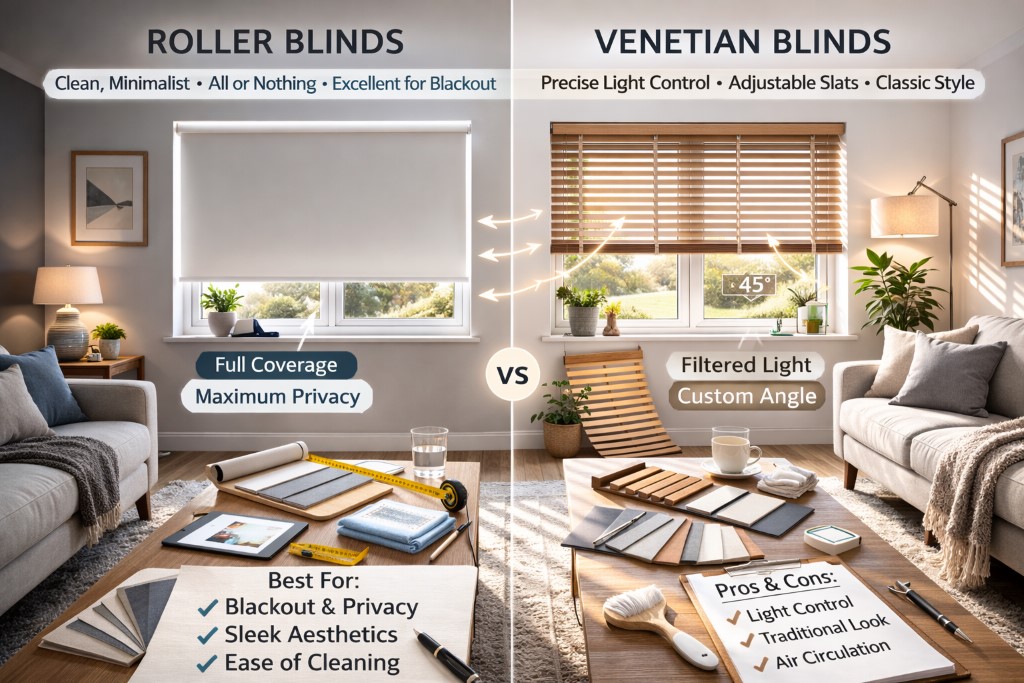
Day and Night vs Roller Blinds
| Feature | Day & Night | Standard Roller |
|---|---|---|
| Light control | Highly adjustable | All or nothing |
| Daytime privacy | Excellent (sheer mode) | Limited (must be down) |
| Blackout available | Near-blackout possible | Full blackout available |
| Aesthetic | Contemporary striped | Clean solid colour |
| Price | Moderate-higher | Budget-moderate |
Choose day and night if: You want adjustable light without lowering/raising the blind completely.
Choose roller blinds if: You need true blackout or prefer a solid colour aesthetic.
Day and Night vs Venetian Blinds
| Feature | Day & Night | Venetian |
|---|---|---|
| Light control | Infinite adjustment | Good (slat tilting) |
| Cleaning | Easy (wipe down) | More time-consuming |
| Aesthetic | Soft, fabric look | Structured, horizontal lines |
| Noise | Silent | Can rattle in drafts |
| Durability | Good | Very good (aluminium/wood) |
Choose day and night if: You prefer fabric aesthetics and want easier cleaning.
Choose venetian blinds if: You want maximum durability and classic styling.
Where Do Day and Night Blinds Work Best?
Living Rooms
The living room is the natural home for day and night blinds. The ability to adjust light throughout the day-bright for morning, filtered for afternoon TV, private for evening-makes them perfect for Ireland’s most-used room.
Bedrooms
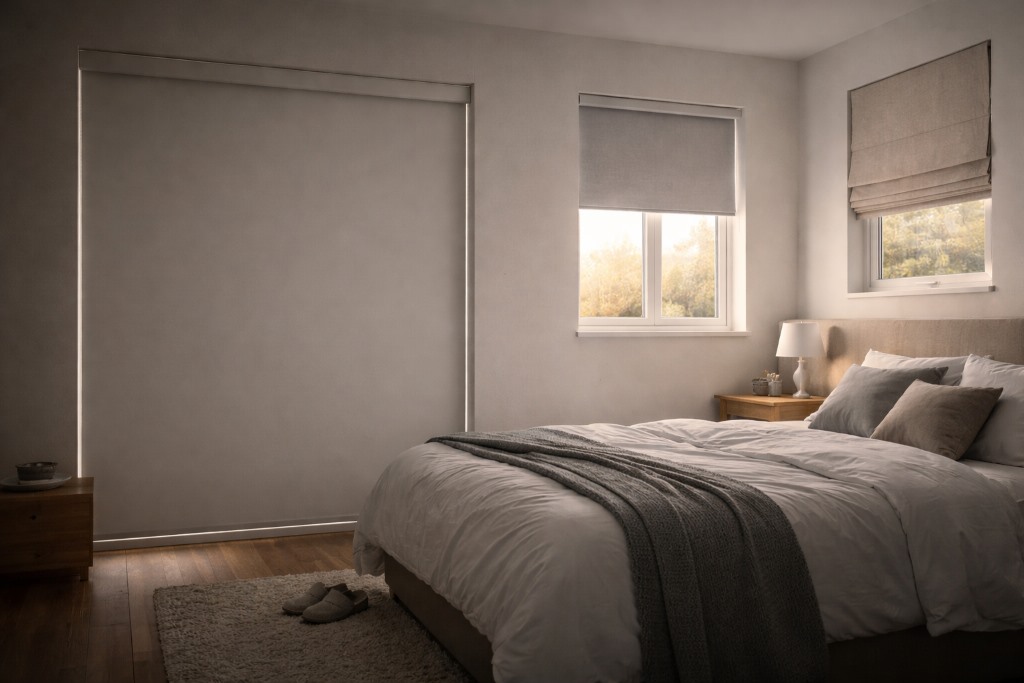
Day and night blinds provide excellent privacy and good light reduction. While they don’t achieve true blackout (some light may filter through where stripes meet), they create a comfortably dark environment for most sleepers. For total darkness, consider layering with blackout curtains.
Home Offices
Screen glare is the enemy of productivity. Day and night blinds let you reduce glare while maintaining enough ambient light to avoid eye strain. Adjust throughout the day as the sun moves.
Dining Rooms
Create atmosphere for evening dinners while keeping bright light for weekend lunches. The versatility suits rooms used at different times for different moods.
Conservatories
The adjustable shading helps manage conservatory temperatures and glare without blocking all that lovely natural light you built the conservatory to enjoy.
Rooms to Consider Carefully
- Nurseries: If your baby needs true blackout, day and night blinds alone may not be sufficient
- Home cinemas: For complete darkness, blackout roller blinds are more effective
- Bathrooms: Standard day and night fabrics aren’t moisture-resistant-check specifications or choose moisture-resistant options
Colours and Styles Available
Day and night blinds have evolved far beyond basic white. Today’s options include:
Popular Colours
- White and cream: Classic choices that brighten rooms and suit any décor
- Grey: The contemporary favourite-works with everything from Scandi to industrial
- Charcoal and black: Bold, dramatic options for modern spaces
- Natural/linen tones: Warm neutrals for softer aesthetics
- Navy and duck egg: Colour options for those wanting more personality
Stripe Widths
Stripe width affects both appearance and function:
- Narrow stripes (25-35mm): Subtle, refined appearance-best for smaller windows
- Wide stripes (50-80mm): Bold, statement look-suits larger windows and modern interiors
Special Finishes
- Metallic threads: Subtle shimmer for glamorous spaces
- Linen-look: Textured fabric for natural, organic feel
- Plain weave: Clean, contemporary finish
How to Measure for Day and Night Blinds
Day and night blinds can be fitted inside your window recess (recess fit) or outside it (face fit). Each approach requires different measurements.
Recess Fit (Inside the Window Frame)
- Measure the width at three points: top, middle, and bottom of the recess
- Use the smallest width measurement
- Measure the height (drop) at three points: left, centre, and right
- Use the smallest drop measurement
- Check the recess depth is at least 75mm to accommodate the mechanism
Face Fit (Outside the Window Frame)
- Measure the width you want the blind to cover (typically window width plus 5-10cm each side)
- Measure from where you want the blind to start (usually above the frame) to where it should finish (usually below the sill)
Top Tips
- Use a metal tape measure for accuracy
- Measure twice, order once
- Note all measurements in millimetres to avoid confusion
- If windows aren’t perfectly square (common in older Irish homes), the smallest measurement ensures the blind fits
For full guidance, see our complete measuring guide.
Day and Night Blind Installation
Installing day and night blinds follows the same process as standard roller blinds. Most homeowners can complete installation in 15-30 minutes per window.
What’s Included
Your made-to-measure day and night blind typically arrives with:
- Blind with pre-attached brackets or brackets to attach
- Fixing screws
- Wall plugs (for face-fit installations)
- Instructions
Basic Installation Steps
- Mark bracket positions: Hold blind in place, mark where brackets should go
- Check level: Use a spirit level to ensure brackets will be even
- Drill pilot holes: For recess fit, drill into the top of the window frame. For face fit, drill into the wall above the window
- Fix brackets: Secure brackets with supplied screws (use wall plugs if drilling into masonry)
- Click blind into brackets: Most modern blinds simply snap into place
- Test operation: Raise and lower to check smooth movement
For detailed instructions, see our roller blind installation guide-the process is identical.
Caring for Day and Night Blinds
Day and night blinds are relatively low-maintenance, but regular care keeps them looking their best:
Regular Dusting
Use a soft, dry cloth or feather duster to remove surface dust weekly. Work horizontally along the stripes.
Light Cleaning
For marks or stains, use a barely damp cloth with mild washing-up liquid. Dab rather than rub to avoid spreading the mark. Allow to dry fully before operating.
What to Avoid
- Harsh chemicals or bleach
- Excessive moisture
- Machine washing (the fabric is bonded to the mechanism)
- Steam cleaning (can damage the fabric bonding)
Mechanism Care
If the blind becomes stiff to operate, check for obstructions. The mechanism shouldn’t need lubrication under normal use.
Frequently Asked Questions
Do day and night blinds provide blackout?
Day and night blinds provide excellent light reduction but not true blackout. In the closed position, some ambient light may filter through where stripes meet. For completely dark rooms, combine with blackout curtains or choose dedicated blackout roller blinds.
Can you get motorised day and night blinds?
Yes! Motorised day and night blinds are increasingly popular, especially for hard-to-reach windows. Control via remote, smartphone app, or voice assistant integration with smart home systems.
Are day and night blinds suitable for bathrooms?
Standard day and night fabrics aren’t designed for high humidity. However, moisture-resistant versions are available specifically for bathrooms. Always check the product specifications.
How long do day and night blinds last?
With normal use and care, quality day and night blinds typically last 8-15 years. The fabric may fade slightly over time with sun exposure, but the mechanism should remain functional throughout.
Can children operate day and night blinds?
Yes, the simple raise/lower operation is easy for children. Modern day and night blinds are available with child-safe chain tensioners or fully cordless options for family safety.
Are day and night blinds energy efficient?
They provide moderate insulation. The double fabric layer offers slightly better thermal performance than single-layer roller blinds. For maximum energy efficiency, choose thicker fabric options or consider thermal-backed alternatives.
Is a Day and Night Blind Right for You?
Day and night blinds offer a unique combination of light control, privacy, and contemporary style that no other blind type quite matches. If you value flexibility, appreciate clean modern aesthetics, and want one window treatment that handles everything from bright mornings to private evenings, they’re an excellent choice.
Key points to remember:
- Versatile light control: From full daylight to near-darkness with one simple adjustment
- Daytime privacy: See out while preventing views in-no need for separate sheers
- Modern aesthetic: Clean lines and contemporary appeal
- Easy to operate: One motion controls everything
- Best for: Living rooms, bedrooms, home offices, dining rooms
- Consider alternatives if: You need true blackout or have high-humidity bathrooms
Ready to try day and night blinds? Order free fabric samples to see the colours and quality for yourself, or browse our full day and night blind collection.